Capturing the precise three-dimensional position of dental implants and transferring that data accurately to a laboratory model is one of the most technically demanding steps in full-arch implant restoration.
Even a small error in this record can have serious consequences. Without achieving perfect passivity, screwing down a full-arch structure creates destructive tension that transfers directly to the surrounding bone. This can trigger bone resorption and eventual implant failure.
What makes this particularly dangerous is how quietly it develops. There is no nerve sensation around the implant to alert the patient, and delivery instruments rarely signal a poor fit, so problems often go undetected for six to nine months.
This is the problem that verification jigs, and now photogrammetry, were designed to address.
Topics in this article:
- What Is an Implant Verification Jig?
- Pros & Cons of Verification Jigs
- The Best Alternative to Verification Jigs: Photogrammetry
- Why Work With Photogrammetry?
- Watersedge: Ottawa’s Photogrammetry Lab
What Is an Implant Verification Jig?
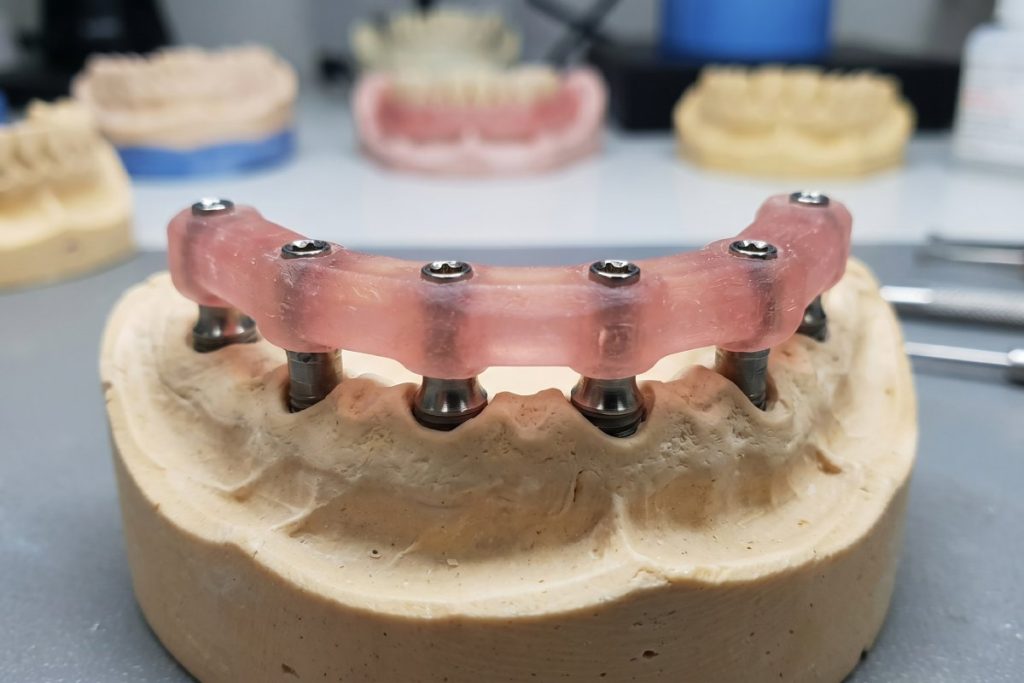
A verification jig is a solid plastic or resin bar connecting impression copings or temporary abutments into a rigid, linked framework. Once a dental laboratory has fabricated a master model from the clinician’s impression or scan, the jig is made to fit that model precisely.
The clinical purpose is straightforward: the clinician tries the jig in the patient’s mouth to confirm the master model is accurate before the lab commits to an expensive milled titanium substructure. If the jig seats passively, the case moves forward. If it doesn’t, a new record must be taken.
Pros & Cons of Verification Jigs
The Pros
Acts as a Vital Safety Net
Verification jigs serve an important purpose in full-arch dental implant cases. They help catch major inaccuracies before the lab mills the final framework, reducing the risk of costly remakes and ill-fitting restorations.
Physical Validation
Unlike a digital model, the jig offers something a clinician can place in the patient’s mouth and observe directly, giving both the lab and the practice a shared point of reference.
The Cons
Flawed Manual Testing
The most common method for checking jig fit is to use a dental explorer. Explorer tips range from 60 to 120 microns in diameter, which means any gap smaller than that threshold is simply invisible to the instrument.
A jig can appear to fit when it doesn’t fit with the level of precision full-arch cases require.
The Appointment Bottleneck
The verification appointment sits in the middle of an already lengthy treatment timeline, adding at minimum one additional visit for the patient and one more scheduling slot for the practice.
High Overhead Costs
From speaking with clinicians, the average chairside overhead is around $475 per hour. When additional verification appointments, remakes, or retakes are needed, they take a measurable bite out of the clinic’s margins.
The Remake Loop
If the jig doesn’t fit, the clinician must take a new record, return the case to the lab, and wait for a new jig before the process can continue. In some cases, this cycle repeats more than once.
Ultimately, the verification jig is a workaround. Traditional impression methods and intraoral scanners on their own can struggle to capture full-arch implant position with the level of precision required for passive fit. Sometimes, dental implants can have micro-movements which aren’t captured.
Research on full-arch implant prostheses continues to emphasize the importance of accurately transferring implant positions and ensuring passive framework fit, which is why verification steps are currently included in these workflows.
The jig appointment exists to compensate for that limitation. It was a necessary step in analog dentistry, but necessity isn’t the same as optimal.
The Best Alternative to Verification Jigs: Photogrammetry
Extraoral photogrammetry represents a fundamentally different approach to capturing implant position data, and it has changed what labs like Watersedge can offer for full-arch cases.
In this context, photogrammetry applies to full-arch implant cases restored at the multi-unit abutment level. It works alongside intraoral scanning rather than replacing it, capturing the implant positions that standard scanning can struggle to record accurately across a full arch.
Using a specialized extraoral camera, specifically the Imetric ICam, the system captures the exact spatial coordinates of small, domino-shaped scan bodies screwed onto multi-unit abutments (MUAs).
Since photogrammetry focuses solely on implant position rather than soft tissue, it is digitally merged with a conventional intraoral scan. A small fiducial marker, typically placed on the palate, is recognized by both scans, allowing the two datasets to be accurately aligned.
The result is a complete clinical picture: micron-level implant coordinates combined with the full anatomical context from the intraoral scan.
Why Work With Photogrammetry?
Unmatched Precision
Traditional impression and scan records can result in a discrepancy of up to 100 microns between implant positions. Photogrammetry narrows that margin to approximately 5 microns.
As Shawn Parisien (Watersedge Laboratory Manager) explains, photogrammetry records the spatial position of implants with enough precision that the lab can move directly from the scan to substructure production, eliminating the verification step entirely.
Elimination of the Jig Appointment
The photogrammetry scan is accurate enough to proceed directly to milling, so the verification appointment is removed from the treatment plan entirely.
Patients skip an extra visit, and clinicians avoid the possibility of needing to retake a record that didn’t pass.
Cost Neutrality
Adding photogrammetry doesn’t raise treatment plan costs. The photogrammetry fee is offset by eliminating analog components like scan bodies, impression copings, and jigs, along with the chair time those steps consumed.
Clinics that have integrated photogrammetry into their workflow have found the cost of switching to be largely neutral.
Industry Trust
The accuracy of photogrammetry scans has earned the confidence of major implant manufacturers. Straumann, one of the largest players in the implant market, will guarantee the fit of a substructure fabricated from a photogrammetry scan.
That kind of commitment signals the clinical trust this technology has earned.
Better Patient Experience
Patients going through full-arch implant treatment have already been through a great deal by the time the final restoration is in sight.
Eliminating extra verification appointments and the need for impression material means fewer delays and fewer frustrating visits. Patients who reach their final restoration on schedule are more satisfied and more likely to refer others.
Watersedge: Ottawa’s Photogrammetry Lab
Verification jigs served a real purpose in an era when impression methods and standard intraoral scanners couldn’t deliver the precision required for full-arch implant cases.
But for full-arch cases, there is now a cleaner, faster, and more precise option.
Watersedge Dental Laboratory was the first dental lab in Ottawa to integrate photogrammetry into its clinical workflow.
With trained technicians, the Imetric ICam, and a mature CAD/CAM digital ecosystem, our experienced team brings chairside photogrammetry directly to your practice, supporting cases across the Ottawa region.
Ready to remove the verification jig entirely from your full-arch implant workflow? Connect with the Watersedge team today.