Photogrammetry
Partner With Us
"*" indicates required fields
Watersedge Dental Laboratory provides photogrammetry services for full-arch implant cases to Ottawa-area dentists and oral surgeons.
Photogrammetry delivers micron-level precision when capturing implant positions, reducing chair time and verification appointments, minimizing remakes, and supporting predictable outcomes in complex full-arch rehabilitation cases.
As early adopters in Ottawa, Watersedge has integrated dental photogrammetry into our established digital ecosystem. Our trained technicians bring the technology to your practice and work directly with your team, complementing your in-house capabilities.

Photogrammetry Services for Dental Implant Treatments
What is Photogrammetry?
Photogrammetry is an extraoral scanning technology used for full-arch implant rehabilitation cases. Unlike intraoral scanners that capture images from inside the mouth, photogrammetry operates from outside the oral cavity, using specialized hardware to record the precise spatial coordinates of implants.
This technology is designed exclusively for full-arch cases involving multi-unit abutments (MUAs), or small connectors placed on top of dental implants to bring the restoration platform closer to tissue level. MUAs help distribute occlusal forces throughout the implant structure and make the restorative process more accessible.
If you’d like more information, give “our guide to what photogrammetry is” a read.
How Photogrammetry Works
Dental photogrammetry utilizes high-resolution triangulation imaging to capture implant coordinates with exceptional accuracy.
The IMetric ICam system, which Watersedge uses, relies on advanced optical technology to identify and record the exact three-dimensional position of each implant relative to the others. The process begins by placing specialized physical objects, called scan bodies, on each MUA. The ICam camera is passed over the patient’s mouth from the outside, capturing multiple images of the scan bodies. The software then calculates the spatial relationship between each implant.
Photogrammetry scans objects, not anatomy. It does not capture soft tissue geometry, contours, the tongue, facial structure, or the implants themselves. Instead, it records the position of scan bodies, which serve as reference points for implant positioning.
To relate this implant position data to the patient’s oral anatomy, a small titanium fiducial marker (typically placed on the palate) is detected by both the photogrammetric and intraoral scans, enabling accurate merging of the two datasets in software.
The Role of Scan Bodies and Multi-Unit Abutments
While photogrammetry captures implant position data, its accuracy depends on the scan bodies and multi-unit abutments (MUAs) used.
The scan bodies are temporary components screwed onto MUAs solely for the purpose of the scan and are removed once records are captured. Watersedge works with all major implant systems, including specialized scan bodies for Straumann and other leading manufacturers.
The accuracy of photogrammetry is rooted in its ability to measure these scan bodies with exceptional precision. Photogrammetry records implant positions within five microns of accuracy. Traditional workflows and intraoral scanning, by comparison, can introduce discrepancies of up to 100 microns and often struggle to capture the full span of a full-arch case without distortion, stitching errors, or drift.
Photogrammetry and Intraoral Scanning: A Coordinated Approach
A common misconception is that photogrammetry replaces intraoral scanning. It does not. The two technologies work together, each fulfilling a distinct role.
- Photogrammetry captures the precise three-dimensional position of each implant relative to the others.
- Intraoral scanning captures detailed images of soft tissue contours, gingival architecture, and the opposing arch. It provides the anatomical context that photogrammetry does not record.
The two scans are merged using the fiducial marker, producing a unified digital master model that includes both the exact implant placement and the surrounding anatomical context needed for restorative planning.
Even minor discrepancies in implant position can result in a non-passive fit that creates tension and stress on implants. A coordinated photogrammetry and intraoral scanning approach enables our laboratory to design and fabricate restorations that fit with exceptional accuracy while respecting the patient’s unique soft-tissue contours and occlusal anatomy.
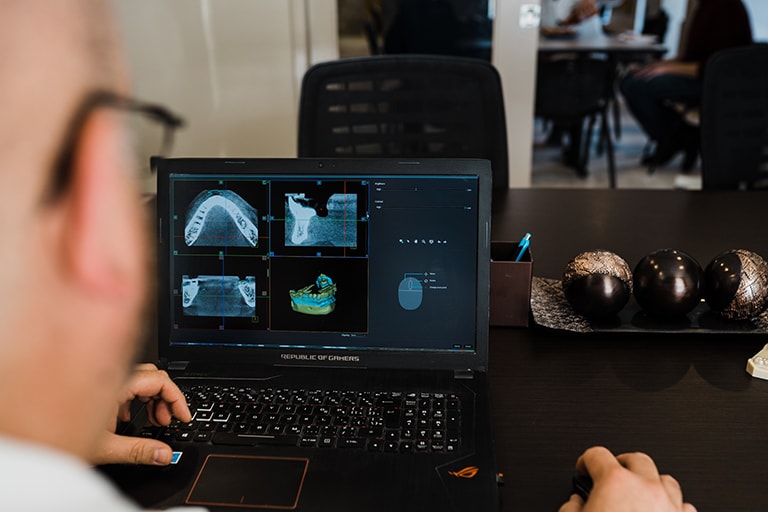
Santa Delivers Innovation at Watersedge
When Health Canada approved photogrammetry for full restorative use in late October 2025, Watersedge moved quickly to secure one of the first six ICam units to arrive in Canada, just in time for the holidays.
The delivery was captured on video—Santa Claus himself delivered a large box and placed it directly under the staff room tree!
The unboxing captured genuine excitement at Watersedge, but the significance of the ICam goes well beyond receiving new equipment. It marks our ability to offer Ottawa-area clinicians a level of precision and predictability that hasn’t been possible before.
We’re proud to bring this technology to our dental partners and support the continued evolution of digital workflows that benefit dental practices and their patients.
Photogrammetry at the Surgical Stage
For patients undergoing full-arch implant surgery, leaving the clinic with a fixed restoration the same day can significantly improve immediate function and overall treatment experience. Photogrammetry makes this possible in a cleaner, faster, and more predictable way than traditional methods.
At the surgical stage, once implants are placed and MUAs are secured, both the photogrammetry scan and the intraoral scan are performed, and the records are processed. Watersedge uses this data to design a transitional restoration for direct attachment to the MUAs, which we fabricate using dedicated 3D printing equipment and dental-grade resin.
Within approximately 80 minutes after surgery, your patients can leave with fixed teeth rather than removable dentures. This transitional restoration is intended to function for up to six months while the implants integrate.
The speed and accuracy of this process allow:
- Reduced chairside time and shorter appointments
- The ability to move to the opposite arch in full-mouth cases
- The flexibility to see other patients while the transitional restoration is printed and finished
- Immediate delivery of fixed teeth rather than removable dentures
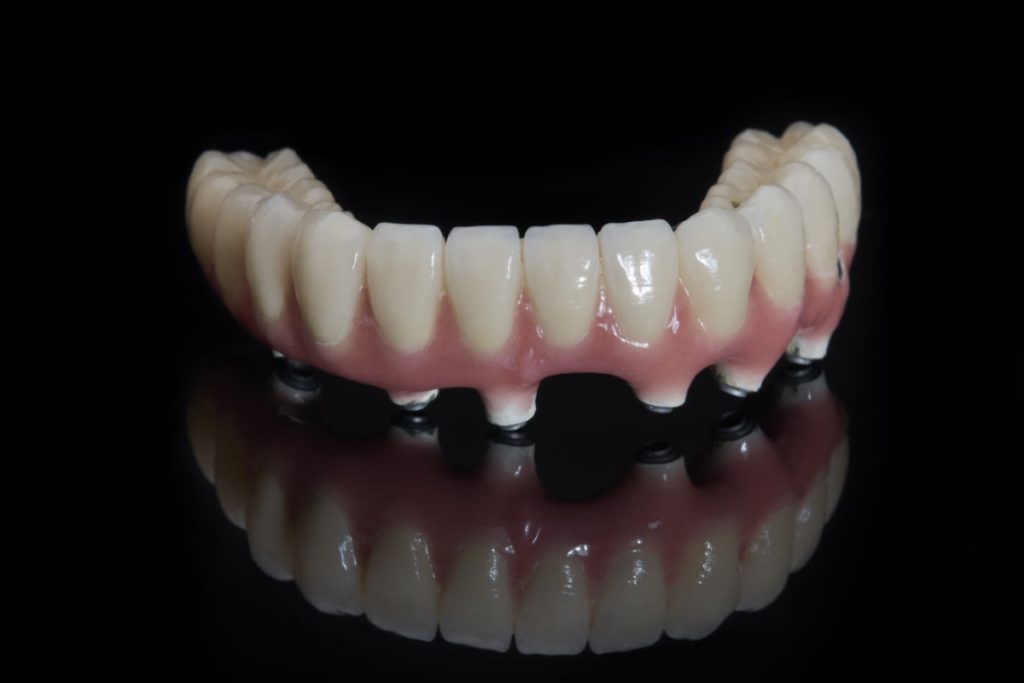
Monolithic 3D-Printed Transitionals vs. Analog
Transitional restorations produced by Watersedge through photogrammetry are monolithic, fabricated as a single, unified structure. This is a significant improvement over the analog method of converting a prefabricated denture into a screw-retained transitional.
In the traditional approach, the denture fabricated before surgery includes several material interfaces, including denture teeth, acrylic, titanium cylinders, and the acrylic used to connect the cylinders. Each interface can become a point of weakness. In addition, because liquid acrylic cures in the mouth, shrinkage can introduce tension and compromise passive fit.
Monolithic printed transitionals eliminate many concerns, offering:
Single-material construction
No joints, seams, or interfaces where failure can occur
Improved fracture resistance
The resin’s slight flexibility provides shock absorption during the initial post-surgical healing period, when patients often lack proprioceptive feedback
Cleaner chairside procedures
No acrylic curing, grinding, or fitting is required during the appointment
Efficient, comfortable delivery
Your patient’s transitional is laboratory-finished and ready for immediate seating
Note: For dental professionals outside Watersedge’s immediate Ottawa service area or clinics that perform full-arch cases less frequently, our technicians will coordinate multi-case days for photogrammetry services. This allows us to support your team with several surgeries during the same visit.
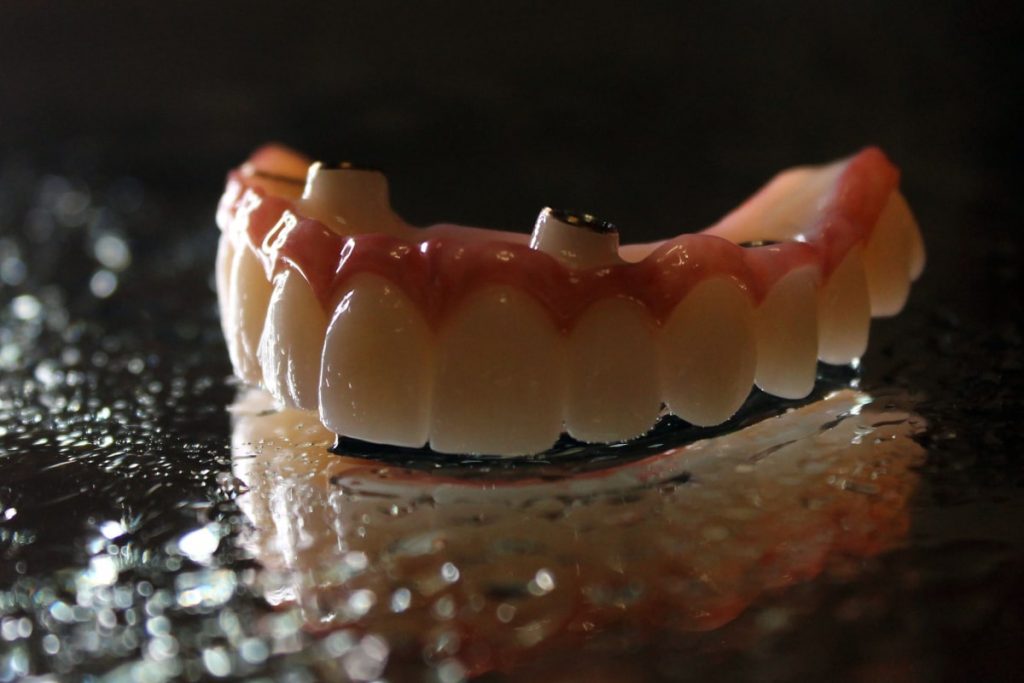
Why Full-Arch Implant Cases Require Two Scans
Full-arch implant positions are captured again at the final restorative stage. Given the accuracy achieved with surgical-stage photogrammetry, it’s reasonable to ask why a second scan is required.
For decades, dentistry has assumed that implants do not move once osseointegration occurs. Photogrammetry has shown that while this is largely true, implants can experience micron-level movement during integration. The changes are small, but measurable and clinically relevant.
A final photogrammetry scan ensures the definitive prosthesis is fabricated based on the current, stable implant positions once bone has remodelled and matured around the implants.
Photogrammetry for Final Restorations
Traditionally, the workflow for fabricating a final full-arch implant restoration involves multiple steps, including a verification jig appointment to confirm the accuracy of the master model before final fabrication. If it does not fit passively, a new record is required, and the process repeats, introducing delays and frustration for clinical teams and patients.
Photogrammetry eliminates the need for verification appointments. With implant positions captured through high-resolution triangulation imaging, our lab can proceed directly from the photogrammetry record to fabrication of the final titanium substructure.
By removing steps designed to compensate for record uncertainty, photogrammetry shortens the traditional treatment timeline by approximately three appointments, including:
- Preliminary impression appointment for the custom tray
- Verification jig appointment
- Potential remake appointments if verification fails
By capturing implant position with exceptional precision, photogrammetry supports passive-fitting restorations from the outset. This reduces the risk of distortion and tension associated with traditional workflows, which—in the worst cases—can contribute to implant failures, and helps protect long-term implant outcomes without the need for verification.
Some implant dentistry manufacturers, including Straumann, are confident enough in photogrammetry’s precision that they guarantee the fit of substructures fabricated from photogrammetry scans.
From the final photogrammetry scan, Watersedge fabricates restorations in a range of materials and designs, such as:
- Monolithic zirconia
- Titanium-reinforced bar structures
- Hybrid acrylic prostheses
Clinical Benefits of Photogrammetry for Ottawa Dentists
One of the most tangible benefits of integrating photogrammetry into your practice is the reduction in the number of required visits.
Traditional methods can involve six or more patient visits between initial records and final delivery. Photogrammetry reduces this to approximately three appointments: the photogrammetry scan, any necessary try-in or adjustments, and final delivery.
Fewer appointments often translates into:
- Fewer scheduling conflicts
- Fewer opportunities for delays
- Reduced disruption to patient flow
- Fewer days patients need to take off work
Just as important, predictability improves when verification appointments are eliminated, and remakes are reduced.
Chair time is one of the most significant expenses in any dental practice.
Verification appointments and corrective adjustments related to record inaccuracy carry a direct cost.
By reducing time-intensive steps in traditional full-arch workflows, Watersedge’s photogrammetry services help ensure accurate fit at delivery.
Faster case progression can also free capacity within your practice to see additional patients.
Enhanced Patient Satisfaction
Patients who experience fewer appointments, stable restorations, and a clear treatment progression are more likely to remain engaged in their care and share positive experiences with others. That level of satisfaction often translates into continued care and patient-driven referrals.
With photogrammetry, patients will experience:
Better fitting restorations
A passive fit reduces pressure on the implants and limits complications associated with tension
More predictable occlusion
Increased accuracy supports consistent occlusal relationships, reducing the need for extensive adjustments at delivery
Faster, less disruptive treatment
Fewer verification and remake visits are needed
Immediate fixed provisionals
Post surgery, patients leave with fixed teeth rather than a removable denture
Reduced anxiety
A predictable workflow reassures patients who are apprehensive about complex treatment
Rapid replacement if needed
In the event of unexpected trauma-related damage, Watersedge can reprint a transitional appliance from the original scan files, minimizing disruption for your patient
The Watersedge Digital Ecosystem
Photogrammetry is one component of a comprehensive digital technology ecosystem that Watersedge has spent years building.
Our investment in digital dentistry predates photogrammetry, and that foundation makes the seamless integration of this technology possible. We’re proud to have added photogrammetry alongside advanced CAD software, high-powered computers, precision milling equipment, 3D printers, and a team of skilled technicians who integrate these tools into a cohesive workflow.
Full-time CAD/CAM designers at Watersedge are proficient at merging photogrammetry and intraoral scans to design restorations that respect both implant positioning and patient anatomy. Our technicians are trained to operate the ICam camera system and to finish and polish 3D-printed transitionals to a level of quality that rivals that of traditional laboratory-fabricated appliances.
Chairside Capability
Watersedge has trained four technicians who travel to clinics, take photogrammetry scans, and support your team throughout surgical and restorative appointments. They’re also prepared to troubleshoot any issues that arise during the photogrammetry process.
Flexible Photogrammetry Support in Ottawa
Watersedge understands that our dental partners have different capabilities and preferences. Some clinics have invested in digital workflows, including 3D printers and CAD design, while others prefer full-service laboratory support.
Our photogrammetry services are structured to accommodate this range:
Full-Service Support
Watersedge performs the photogrammetry and intraoral scans, designs and prints the transitional restoration, and delivers the finished appliance to your clinic.
Scan + Design Files for In-House Printing
For practices with compatible printers and trained staff, Watersedge provides the scan and design files to clinics for in-house printing and completion.
Photogrammetry Scan Only
For practices with design capability but no ICam system, Watersedge can capture the photogrammetry record and deliver the digital files for integration into your workflow.
For practices within Watersedge’s local service area—from Manotick to Gatineau and from Carleton Place to Rockland—printed transitionals can be delivered using our fleet of four vehicles and drivers.
For practices outside this area, our team coordinates multi-case days and travels with mobile equipment.
Watersedge has absorbed the investment required to implement photogrammetry, including equipment, software, and training, to keep the service accessible for clinicians.
By eliminating or reducing traditional workflow steps, such as verification jigs, remakes, and additional appointments, photogrammetry helps offset any additional costs. In many cases, the overall cost to the clinician remains comparable to traditional approaches, while supporting more efficient case progression.
FAQs
Photogrammetry is an extraoral scanning technology that captures the precise three-dimensional position of dental implants, while intraoral scanning captures soft tissue contours and tooth structure. For full-arch restorations, both are used to create a precise digital model.
Yes. Trained Watersedge technicians bring the ICam camera system directly to your clinic for both surgical and restorative appointments. For Ottawa-area practices, transitional restorations can be prepared and delivered from our laboratory. For practices outside our immediate service area, we coordinate multi-case days and arrive with mobile 3D printing technology.
Contact Watersedge as early as possible during case planning. Interest in photogrammetry services across the Ottawa area is high, and scheduling fills quickly. For practices outside our immediate service area, booking multiple cases together allows us to plan travel more efficiently.
Photogrammetry is designed for full-arch implant rehabilitation cases using multi-unit abutments (MUAs). The technology is used at the surgical stage for immediate transitionals and at the final restorative stage. If you’re unsure whether your case is suitable, our team is available for consultation.
Watersedge provides photogrammetry services throughout the Ottawa area. For practices outside the region, we can recommend trusted laboratories using similar technology or discuss custom solutions on a case-by-case basis.
Watersedge has absorbed the investments required to integrate photogrammetry systems into our digital workflow, making overall case costs comparable to traditional approaches. We offer flexible à la carte pricing to meet the needs of any practice.
Partnership and Collaboration with Ottawa Dentists
Full-arch implant cases are complex and often involve coordination between surgeons, restorative dentists, and the laboratory. Success depends on communication, trust, and shared commitment to the patient’s outcome.
Photogrammetry fits naturally into Watersedge’s collaborative approach. Our team remains available for pre-treatment consultations, case-suitability discussions, and scheduling coordination throughout the course of treatment.
Recognizing its impact on full-arch implant outcomes, Watersedge adopted photogrammetry technology early and invested in the systems and training required to support it. Our technicians travelled to observe live cases at established laboratories already using the technology and photogrammetry software, and we continue to maintain professional relationships with other photogrammetry labs to stay current as protocols evolve.
When a Watersedge technician arrives at your clinic, you are working with a professional who has been thoroughly trained, has supported numerous cases, and understands both the technology and the clinical context in which it is used.
Customer service is central to who we are. From initial consultation through final delivery, our team remains responsive, ensuring continuity, clarity, and confidence at every stage of the case. That commitment continues after our technicians leave your clinic.
For practices new to photogrammetry, Watersedge can arrange opportunities to tour the laboratory, see the technology in use, and ask questions.
Beyond education and onboarding, we remain actively involved when patient needs arise. For example, if an unexpected complication occurs—such as a broken restoration due to facial trauma or an accident—Watersedge can reprint a transitional appliance from the original scan files to provide fast support for your patient.
Get Started with Photogrammetry at Watersedge
If you are planning a full-arch implant case and want to explore how photogrammetry can improve accuracy, reduce the number of appointments, and support predictable outcomes, contact Watersedge Dental Lab today.
We’re available at anytime to discuss case suitability, scheduling, and how photogrammetry can fit into your existing workflow.